Theranostics in Nuclear Medicine
Future prospects and growth potential of theranostics
Theranostics is attracting interest as a next-generation cancer treatment.
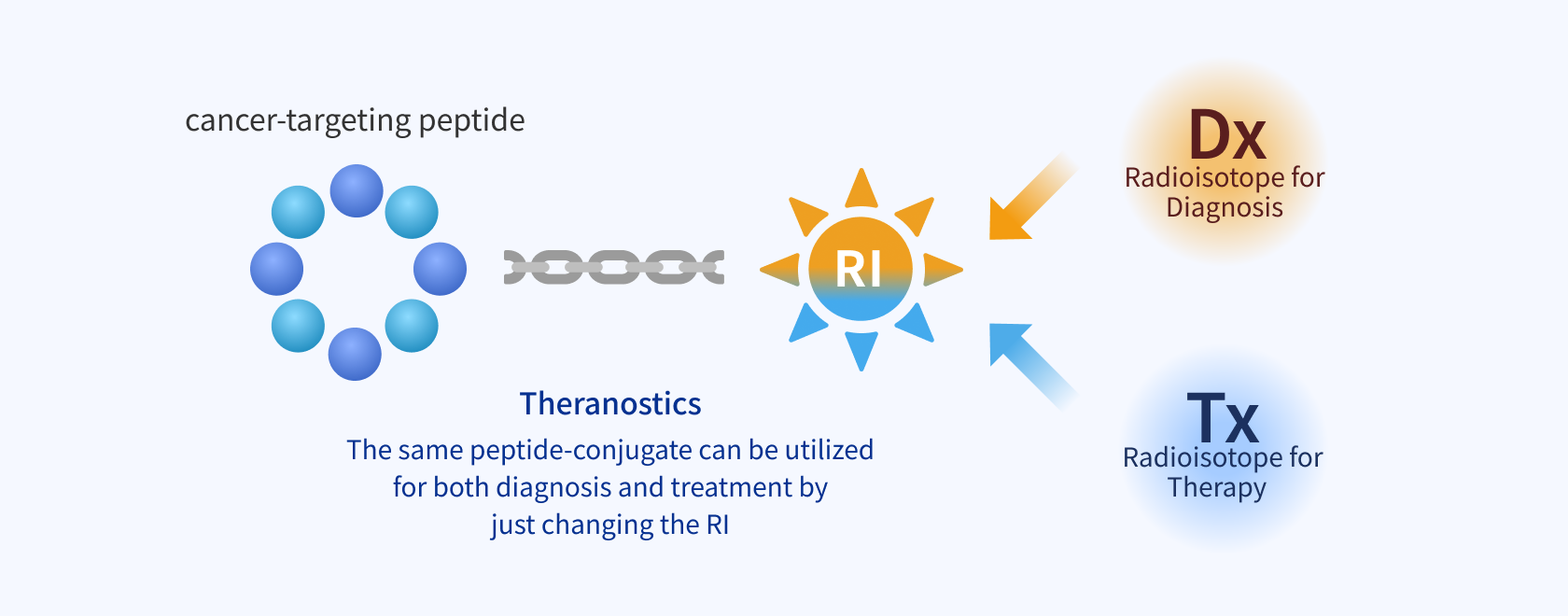
Theranostics is a portmanteau of two words: therapeutics and diagnostics.
Theranostics uses a substance (such as a compound, antibody, or peptide, etc.) that accumulates in target cancer cells. In diagnosis, a radiopharmaceutical created by combining this substance with a diagnostic RI is administered and detected using a specialized camera to identify the location and size of the cancer. In therapy, a radiopharmaceutical created by combining the same substance with a therapeutic RI is administered to target and destroy cancer cells.
Features of theranostics
Theranostics using RI offers the following features:
-Potential treatment effectiveness can be assessed in advance
A diagnostic radiopharmaceutical is used to determine whether the radiopharmaceutical accumulates in the tumor. Since only patients likely to benefit from the therapy will receive it, ineffective treatments can be avoided.
-Treatment can be optimized for each patient
Depending on the degree of the radiopharmaceutical uptake observed during diagnosis, side effects may be predicted and the drug doses can be adjusted. This helps in personalizing the therapy.
-Therapeutic effects can be continuously monitored
The radiopharmaceutical used during the initial diagnosis can also be used to evaluate treatment response after therapy. The treatment plan may be adjusted as needed while monitoring the therapy progress.
See it & Treat it!!
This new approach, which links diagnosis and therapy, aims to provide more precise and efficient cancer treatment.
Theranostics is attracting interest as a highly effective therapy with fewer side effects, and research and development efforts are intensifying worldwide.
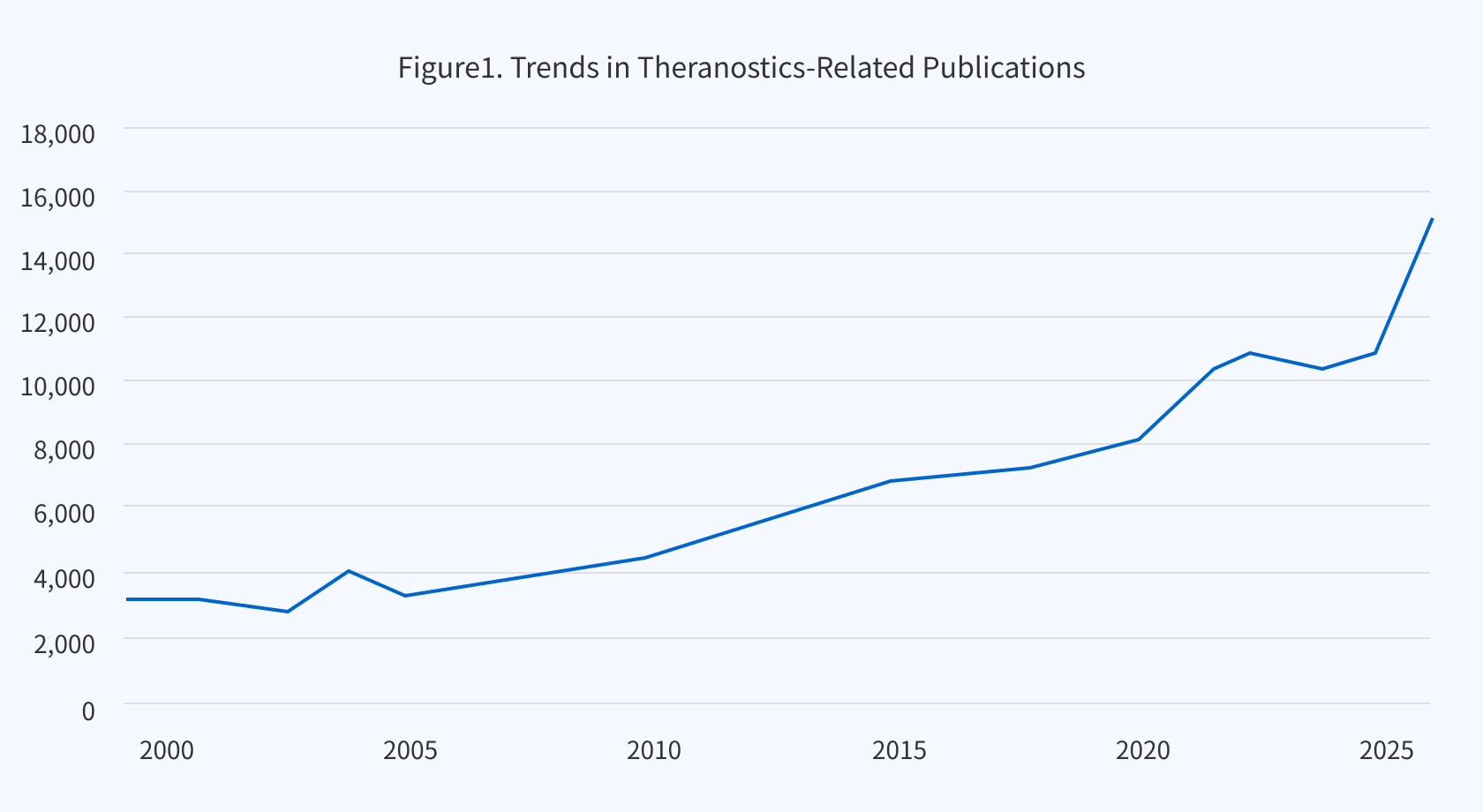
According to Lancet Oncology 1), its applications in diagnoses and treatments rapidly increased particularly in the field of oncology over the past 20 years. Moreover, in Annals of Nuclear Medicine 2) and Frontiers in Nuclear Medicine 3) , researchers pointed out that interest in theranostics has increased with development of new RIs and improvements in compounds that deliver RIs to cancer cells. The number of publications related to "theranostics" has also increased rapidly in recent years (Fig.1), indicating active research and development initiatives.
Pharmaceutical companies are actively developing theranostic therapies, and the number of clinically available therapies is expected to increase also in Japan in the coming years.
1)Scott, Andrew M et al. Trends in nuclear medicine and the radiopharmaceutical sciences in oncology: workforce challenges and training in the age of theranostics. The Lancet Oncology, Volume 25, Issue 6, e250 - e259
2)Watabe, T., Hirata, K., Iima, M. et al. Recent advances in theranostics and oncology PET: emerging radionuclides and targets. Ann Nucl Med 39, 909-921 (2025).
3)Zhai C and Bobba KN (2024) Editorial: Recent advances in radiotheranostics. Front. Nucl. Med. 4:1520778.